Kafue National Park Management
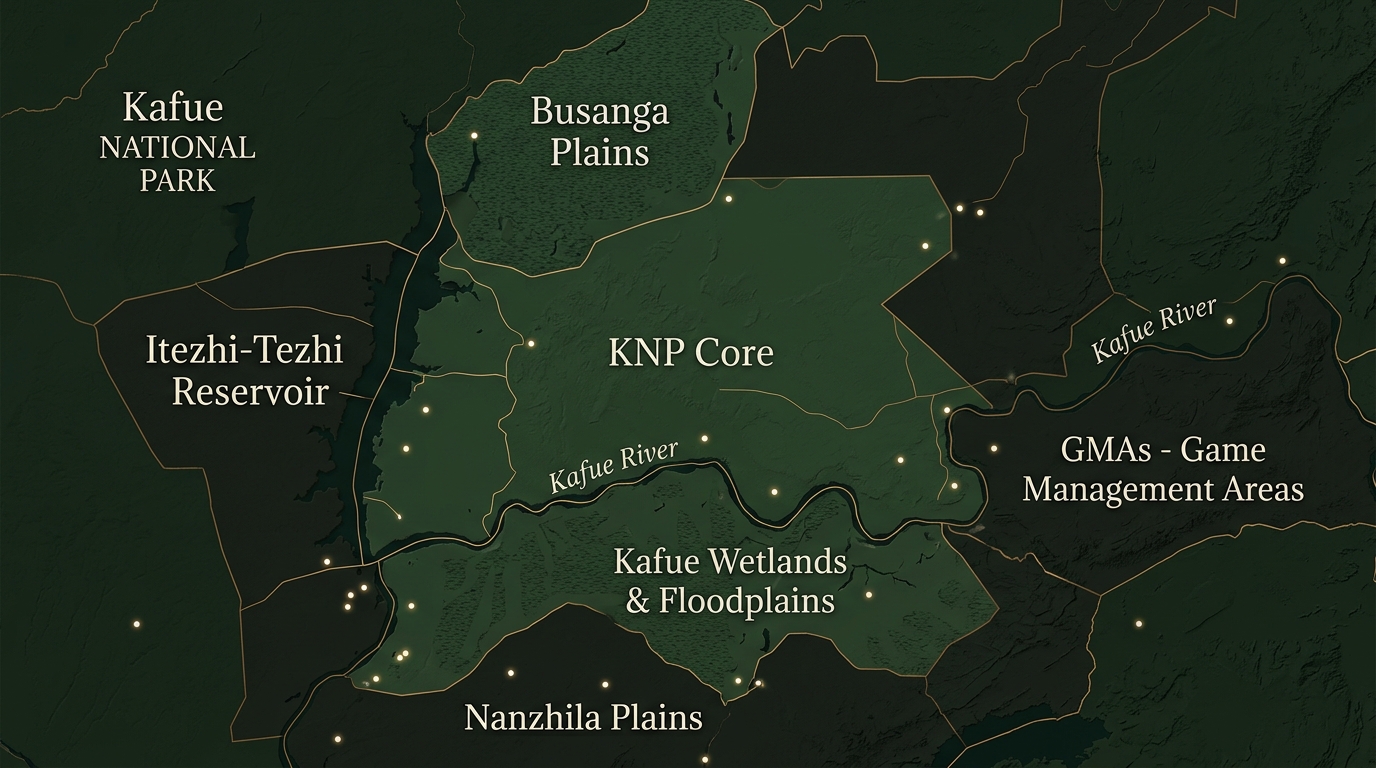
A landmark long-term management partnership covering all of Kafue National Park. African Parks works alongside the Department of National Parks & Wildlife to deliver law enforcement across 22,400 km², rebuild infrastructure, manage community development, and restore ecological balance across the park's diverse habitats.
Law Enforcement
Infrastructure
Community Development
KNP Core
Zone: Kafue National Park
Scale: 22,400 km²
Wildlife Restoration Programme
Actively restoring depleted wildlife populations across Kafue. The programme includes large-scale translocations of zebra, wildebeest, and Kafue lechwe — a species endemic to Zambia's floodplains — alongside ongoing monitoring to track population recovery and genetic health.
Kafue Lechwe
Zebra
Wildebeest
Translocation
Zone: KNP / Floodplains
Focus: Biodiversity
Special Anti-Poaching Unit (SAPU)
GRI operates three dedicated anti-poaching units — SAPU North, SAPU South, and SAPU KAZA — providing intelligence-led patrol operations, rapid response capabilities, and K9 tracking teams across the GMAs surrounding Kafue. These units are the primary frontline against commercial poaching in the buffer zones.
K9 Units
Intelligence-Led
Rapid Response
GMAs
Zone: Game Management Areas
Focus: Wildlife Protection
Connected Conservation Initiative
A technology-led conservation programme operating around Lake Itezhi-Tezhi, deploying thermal imaging cameras, sensor networks, and communications infrastructure to detect and deter illegal activity in real time. The system feeds live intelligence to patrol teams, dramatically reducing response times to poaching incidents.
Thermal Imaging
Sensor Networks
Itezhi-Tezhi
Real-Time Intelligence
Zone: Itezhi-Tezhi
Focus: Law Enforcement
Community Wildlife Protection Project
Working with chiefdom communities across the Greater Kafue landscape to build a culture of conservation from within. The project trains and employs community game scouts, establishes community wildlife accounts, and creates sustainable income streams — making it economically rational to protect, rather than poach, wildlife.
Community Scouts
Livelihoods
Human-Wildlife Conflict
GMAs
Zone: Game Management Areas
Focus: Livelihoods
Greater Kafue Landscape Monitoring
Operating from a field research base in the GMAs, Musekese combines long-term ecological monitoring with embedded ranger operations and deep community relationships. Their work tracks predator populations, prey dynamics, and land-use change — providing critical baseline data for evidence-based conservation management.
Lion
Leopard
Wild Dog
Ecological Monitoring
Zone: GMAs / Busanga
Focus: Predator Research
Kafue Conservation Technology
Deploying cutting-edge monitoring technology including elephant GPS collars, satellite tracking, and movement corridor analysis across the Kafue sub-basin. This work maps critical wildlife corridors between Kafue and adjacent landscapes, informing land-use planning to prevent habitat fragmentation.
Elephant
GPS Collaring
Wildlife Corridors
Kafue Sub-Basin
Zone: Kafue Sub-Basin
Focus: Connectivity
Kafue Wetlands Monitoring Programme
A collaborative ecological monitoring programme focused on the Kafue Flats and wetland habitats — one of the most biodiverse freshwater ecosystems in Southern Africa. The programme monitors Wattled Crane populations, waterbird diversity, fish stocks, and hydrological health of the floodplain system.
Wattled Crane
Wetlands
Kafue Flats
Hydrology
Zone: Kafue Wetlands
Focus: Freshwater Biodiversity
Greater Kafue Community Engagement
TNC's Kafue programme supports community resource boards, land-use planning, and human-wildlife conflict mitigation across chiefdoms bordering the park. Their approach integrates conservation science with community decision-making, ensuring that local governance structures lead conservation outcomes.
Human-Wildlife Conflict
Land-Use Planning
Community Boards
Park Periphery
Zone: Park Periphery
Focus: Coexistence
Climate Resilience & Livelihoods
Various Partners (incl.
AfDB)
Supporting women-led cooperatives and boundary communities in sustainable forest-based livelihoods including non-timber forest products, community beekeeping, and solar-powered agro-processing. The programme builds economic resilience to climate shocks while reducing pressure on natural resources.
Beekeeping
Women-Led
Solar Enterprise
Forest Products
Zone: Kafue Sub-Basin
Focus: Climate Adaptation
This directory is continuously updated. Inclusion does not imply formal endorsement by the Kafue Conservancy. Descriptions are based on publicly available information.